WHO / Quinn Mattingly
© Credits

Estimating the burden of foodborne diseases

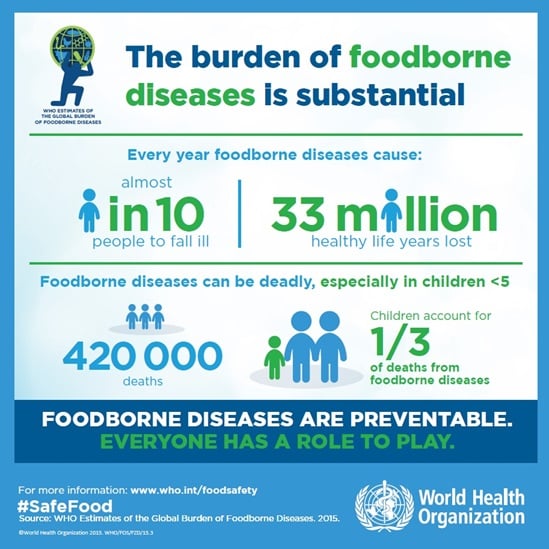
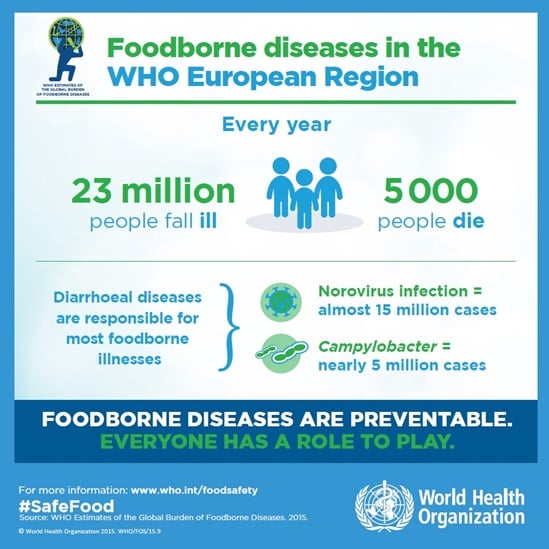
Each year worldwide, an estimated 866 million – almost 1 in 9 people – fall ill after eating contaminated food, resulting in 1.52 million deaths. Children under the age of 5 bear nearly one-third of all cases of foodborne diseases. WHO estimated that 57.1 million years of healthy lives are lost due to eating unsafe food globally each year.

Foodborne diseases are preventable and WHO has a critical role in taking global leadership in investment and coordinated action across multiple sectors in order to build strong and resilient national food safety systems and provide consumers with tools to make safe food choices. With food safety receiving relatively little political attention, especially in developing countries, having a reliable data on the actual national burden of foodborne diseases is essential to draw public attention and mobilize political will and resources to combat foodborne diseases.

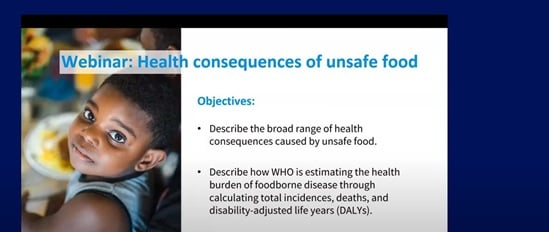
World Health Assembly Resolution 73.5 (WHA73.5) mandated WHO to monitor regularly and to report to Member States on the global burden of foodborne and zoonotic diseases at national, regional and international levels. It also mandated the preparation of a new report on the global burden of foodborne diseases with up-to-date estimates of global foodborne disease incidence, mortality and disease burden in terms of disability-adjusted life years (DALYs). To achieve this resolution, WHO released a complete set of estimates in 2026, and the underlying databases will be regularly updated afterwards.

One in 9 people

fall ill

after eating contaminated food worldwide

Learn more

1.52 million

people

die each year due to unsafe food

Learn more

US$ 310 billion

lost each year

in productivity resulting from unsafe food

Learn more

Database

The burden of foodborne diseases is not spread equally across the globe but correlates with the socio-economic development of countries. The global database on foodborne disease burden displays the estimates on an interactive map.

The Foodborne disease burden database search platform is being updated and will be available for users soon. For data requests, contact fbd-burden@who.int.

Publications

All →
What are healthy diets? Joint statement by the Food and Agriculture Organization of the United Nations and the World Health Organization

Healthy diets promote health, growth and development, support active lifestyles, prevent nutrient deficiencies and excesses, communicable and noncommunicable...

FAO/WHO background document on the risks and benefits of fish consumption

The report of the first Joint FAO/WHO Expert Consultation on the Risks and Benefits of Fish Consumption was published in 2010. Since then, new literature,...

World Food Safety Day 2023: growing a greater awareness of food standards

In 2023, over 500 events were organized in at least 139 countries on the occasion of World Food Safety Day. Many of those were technical conferences...

Prevention and control of microbiological hazards in fresh fruits and vegetables: parts 1 & 2: general principles: meeting report

Fruits and vegetables are an important part of a healthy diet and are protective against many chronic health conditions. Yet, fresh fruits and vegetables...

Whole genome sequencing as a tool to strengthen foodborne disease surveillance and response: module 1: introductory module

Whole genome sequencing (WGS) is a laboratory technique that has the potential to change how we detect and monitor microbial hazards in the food chain,...